
HAU TAKI HAERE Tertiary Update No 13, 2026.
21 July 2026

Pay equity conversation Auckland
Last night in Auckland we held the first of our Pay Equity Conversations — a series of events bringing together people who care about pay equity and want to make sure this year's General Election is an equity election.
A fantastic panel discussion took place at the University of Auckland, MC'd by the TEU's own Amy Ross. We were lucky to have a superstar line-up of panellists: Falguni Pachchigar, a PSA delegate and home support worker; TEU members Zoë Port and Julie Douglas; and Lynne Pillay, a former Labour MP and member of the People's Select Committee. Together they wove a rich tapestry of conversation, showing us that pay equity is fundamental to our wellbeing, our security and our future.
Around 50 people attended, including TEU members, members of other unions, the Equal Employment Opportunities Commissioner Gail Pacheco and many long-time advocates for pay equity. We were determined as a group to not allow this coalition governments shocking overnight gutting of our equal pay legislation to be forgotten at election time.
There were plenty of standout moments. Julie Douglas reminded us how important it is to keep pay equity framed as an issue of justice and fairness; when we get drawn into arguments about cost, we dilute the strength of our case. Human rights are not up for debate! Pay equity must be achieved because it is just and fair.
Two more Pay Equity Conversations are scheduled for next month: get amongst it! Each one will have a member of the peoples select committee present -Lianne Dalziel in Christchurch on 25 August and Ria Bond in Invercargill on 26 August.
You can register to attend here 2026 Pay Equity Conversations
For more information check out the TEU website here Pay Equity Conversations | Tertiary Education Union – Te Hautū Kahurangi o Aotearoa

What is a clawback and what do we do about them?
Across the country, in universities and polytechnics, employers are cutting back – on jobs, programmes, and on our terms and conditions. This is why your engagement in your union is critical to resistance and to winning better terms and conditions. Kotahitanga – unity and collective solidarity – makes us stronger!
We defend our terms and conditions under our collective agreements through negotiations. As a union, we have mechanisms to better our terms and conditions and to resist detrimental changes.
The TEU's Industrial and Professional Committee has a National Industrial Advisory Group made up of members, your national Co-Presidents and specialist staff who work with negotiation teams on clawbacks on the table. Clawbacks affect us all. The Advisory Group can support the advocates and team members by advising on negotiating those clauses and can recommend strategies to communicate and take action to defend the rights we have previously won in our collective agreements.
What is a clawback?
A clawback is an action by the employer to strip away or eliminate benefits that we have worked hard for in our collective bargaining over years of negotiating and campaigning for Good Work.
An example of a clawback can be seen in the current polytech negotiations where some employers want to move from the multi-employer collective agreement (where terms and conditions are shared by staff working in polytechs across the country), to a single employer collective agreement. For staff in polytechs, moving to a single employer collective agreement may mean starting from a blank slate – not taking those terms and conditions we've won over the years along with us. This would be a massive clawback from employers affecting all parts of polytech staff terms and conditions. This is why we are campaigning to continue our multi-employer collective agreement.
Clawbacks occur at universities too. Employers in the sector often try to cut or "grandparent” payments to employees who are retiring. Universities have also attempted to cut allowances for prescription glasses or sought changes to organisational change processes to ‘reduce stress on employees being made redundant’.
Clawback language
Often you might hear talk from employers about ‘efficiencies'. Phrases get used like ‘creating modern terms and conditions’ or ‘aligning with local or regional needs’. Generally these changes do not benefit staff and are code for clawbacks.
What can we do about it?
Resistance to clawbacks is core union business, and your Industrial and Professional Committee as well as your negotiating teams always have strategies to work through.
But the resistance and building of our terms and conditions must come from all of us.
You can support your negotiations team by turning up at TEU Tuesday activities, wearing a TEU Mahi Tika tee-shirt and generally being visible as 'union' at work.
A negotiating team needs to know that their colleagues have their backs. At different times they might need us to amplify their voice – so that our employer can hear loud and clear what we want to keep in our collective agreements. That is what being in union is all about!
Member portal update
A reminder to everyone to activate their link to the TEU membership portal! (Check your emails for the link from Kurt.)
Already the portal has been accessed by thousands of members, and hundreds of members have updated their membership information. This is fantastic news!
There has been significant growth in our network groups with some networks increasing by up to 90% since the portal went live. Members connecting and engaging with other members around shared interests and issues is what being in union is all about.
Cost of tertiary education now 19% higher than 2 years ago
The following media release was published on 9 July 2026.
The union for academics and staff working in universities, polytechnics and wānanga say that the proposal to permit tertiary institutions to increase student fees to 6% in a year when fees-free support has been withdrawn is unacceptable and irresponsible.
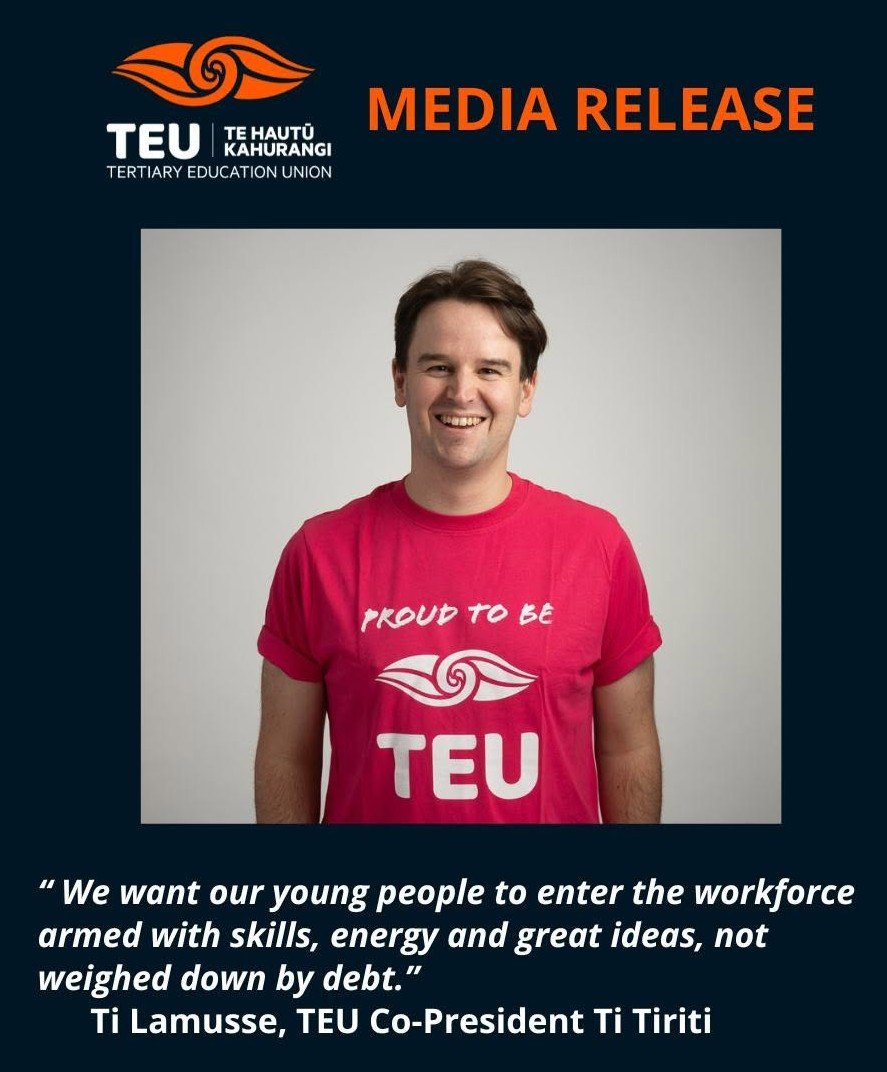
President Te Tiriti for the Tertiary Education Union (TEU), Ti Lamusse, says the 6% addition proposed by the Government in the Annual Maximum Fee Movement would push fees for New Zealand students to more than 19% above 2024 levels.
"Everyone is suffering from the cost-of-living crisis. To remove fees free and to push student costs and debt even higher is cruel, short-term thinking by this Government."
Ti Lamusse says that students are being asked to absorb fee increases at nearly double the rate of general price increases. Inflation currently sits at 3.1%.
"This puts the burden of education on the shoulders of young people and their whānau. We want our young people to enter the workforce armed with skills, energy and great ideas, not weighed down by debt.
"Ultimately TEU believes education is a public good and it should be freely accessible to all. We want to set our young people up for success, not use their education as a profit-making machine."
Aidan Donoghue, President of Victoria University of Wellington Students’ Association (VUWSA) says students are doing it hard.
In a recent State of the Student Survey conducted by VUWSA with 1200 students at Victoria University, 38% of respondents said they had skipped a meal in the last fortnight.
"Our everyday living costs and debt have been compounded. Having fees free ripped away from us was an absolute kick in the teeth. I had a student phone me in tears after the announcement, because they’d budgeted their education under the assumption that their last year would be free. They've now left university.
"Students I talk to are wondering why they’d stay in New Zealand. We’re talking about losing the next generation of nurses, teachers, doctors, agricultural workers and engineers - highly skilled people who should be moving into our workforce, but they can’t see why they’d stay with the level of debt and cost and a better lifestyle overseas. There’s a sense that there’s no support for them here in their own country."
Ti Lamusse says the Annual Maximum Fee Movement has become a mechanism for passing the chronic government underfunding of universities, polytechnics and wānanga onto students.
"The answer to creating a thriving society for our young people is proper government investment, not higher fees.
TEU Submission on theTertiary Research Excellence Fund (TREF)
The Ministry of Education recently consulted on 2027 tertiary funding determinations, including a new determination for the Tertiary Research Excellence Fund (TREF). Set to replace the PBRF from 2029, the TREF risks entrenching a two-tier system that will leave polytechnics and wānanga competing for a tiny, diluted share of research funding, while its citation-based metrics will further undervalue the humanities, social sciences, and mātauranga Māori research relative to STEM.
Our submission calls for real transitional support for polytechnics and wānanga, and increased overall investment in research – not just a new way of dividing up a research fund that continues to decrease in real terms.